The Cathedral Building
History records that on March
13th, 1843, Governor James Douglas, accompanied by a Father Bolduc,
arrived at Fort Victoria from Fort Vancouver on the Columbia River.
As Hudson's Bay Company Factor, Douglas was charged with the
responsibility of assessing the possibility of establishing a trading
centre on Vancouver Island.
They arrived off Cadboro Bay aboard the Hudson's Bay Company
sailing ship 'The Beaver'. In anticipation of Sunday, Father
Bolduc spent the day in preparation of a rustic chapel to
celebrate the Lord's Day, with the aid of several of Douglas'
men.
Branches of fir trees enclosed the sides, a boat awning served
as a canopy. Father Bolduc wrote a description of that event:
Early Sunday morning more than 1200 Indians surrounded the
humble chapel. Our host, Chief Factor Douglas, left nothing to
help make the ceremony imposing. I was welcome to take on shore
anything and everything that might be used as an object of
decoration. He, himself, was present at Mass, as well as several
Canadian and two Catholic women, wrote the priest.
November 1, 1858, Roman Catholics of Victoria made their way to
Humboldt Street to attend the first Mass in Victoria's original
Cathedral. This was to become the Chapel of St. Ann's Convent
across from Victoria's General Hospital (later St. Joseph's
Hospital) on Humboldt Street. The second Cathedral, 1884- 1892
was located on a lot adjacent to the present Cathedral site.
(The current St. Andrew's Square building).
The Present Cathedral
Bishop J.N. Lemmens (1888 -
1897) wanted Victoria to have an inspiring Cathedral. He
journeyed to Quebec to locate a church building which he might
duplicate in Victoria. The church of Longueil was his choice.
On
February 11, 1890, the Daily Colonist newspaper announced that
working plans had been received by Bishop Lemmens for the new
St. Andrew's Cathedral. Shortly thereafter, Bishop Lemmens laid
before his congregation the construction tenders. A vote
determined that the tender of Aeneas McDonald, for the sum of
$81,052.00, be accepted. So work began on Victoria's second
Cathedral church.
While the decision to build the
new Cathedral was announced in 1882, construction did not begin
until 1890.
History recorded that on October 30, 1892, Bishop Lemmens
blessed the new cathedral at 8 a.m. At 9 a.m. he moved the
Blessed Sacrament from the old Cathedral to the new. At 10 a.m.
he sang a Pontifical High Mass. The band of Her Majesty's
Ship 'Warspite' played a fanfare as Bishop Lemmens with his clergy
entered the packed Cathedral.
The
attending congregation was 2000 strong. The church was indeed a
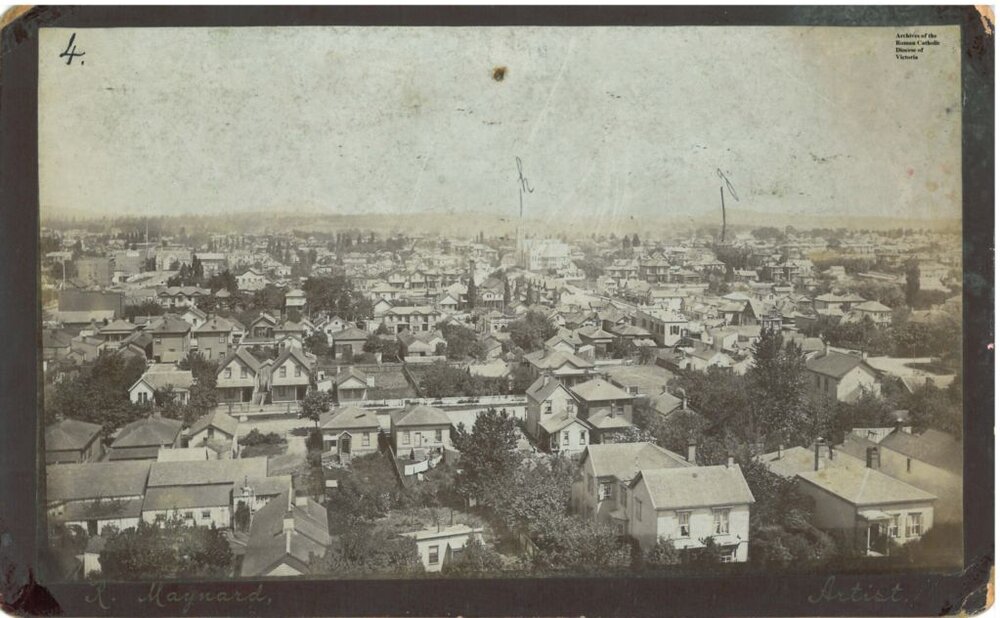
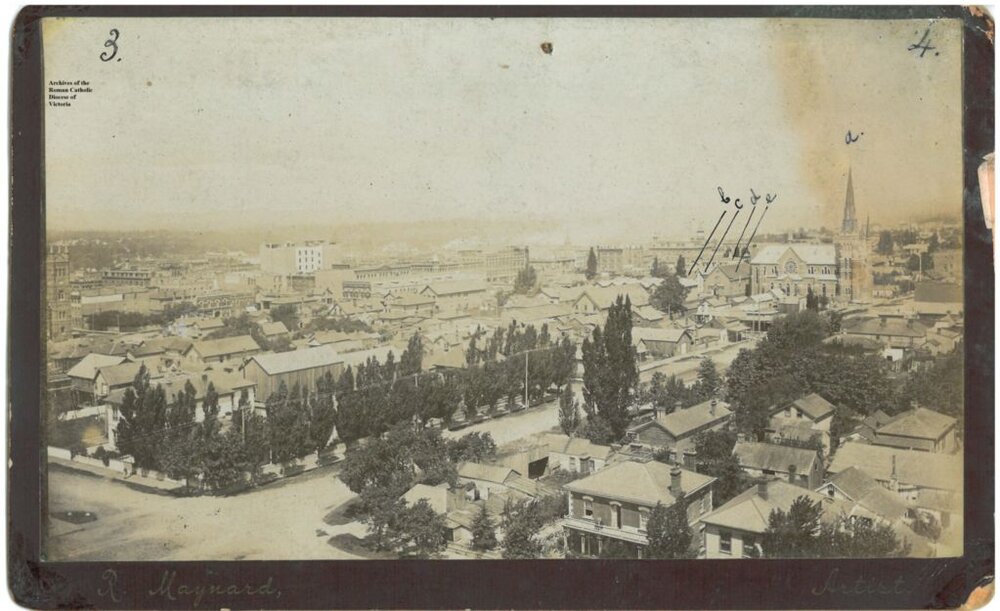
major architectural landmark on the skyline of the young city of
Victoria. The design reflects continued Catholic cultural links
to Quebec. Perhaps most significant of all, the prestigious
Montreal church architects, Monsieur Maurice Perrault & Monsieur
Albert Mesnard, duplicated the plans of a parish church which
they had already supplied for Vaudreuill, P.Q.
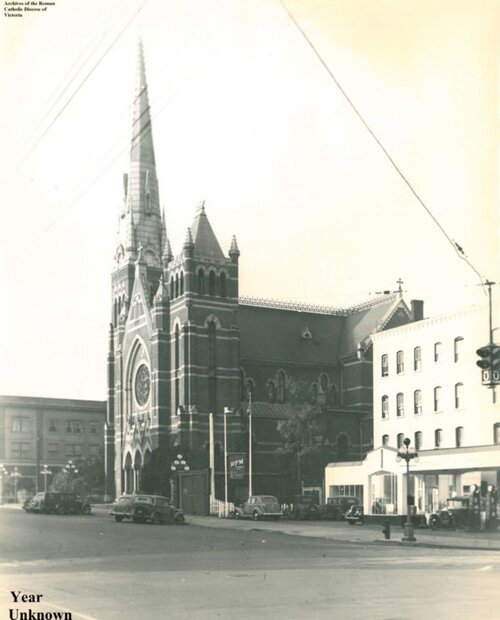
However
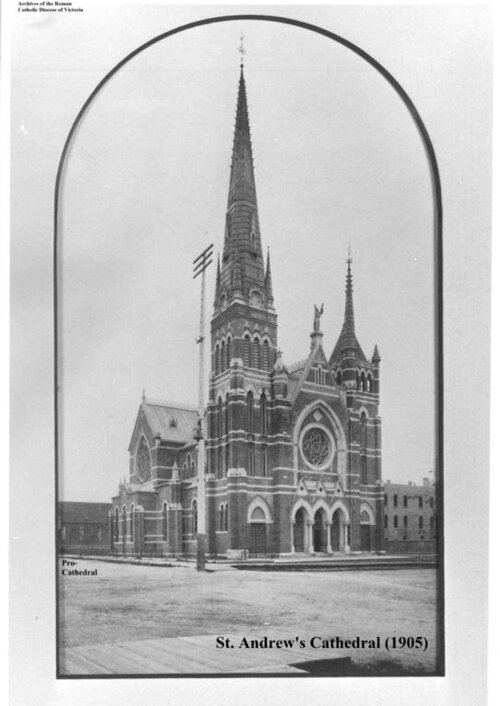
there are numerous changes. In particular, the brick envelope
articulated with ashlar stringcourses and diaperwork. The double
towered facade is typical of Quebec churches although a hallmark
of the High Victorian Gothic is the asymmetrical treatment. The
seventy-two foot centre bay with its recessed rose window is
dominated by the main tower terminating in a 175 foot spire.
This tower, constructed to accommodate a clock and chime of
bells, is balanced by a shorter tower on the north side,
purposely truncated to emulate the "unfinished" look of the
great European fourteenth and fifteenth century ancestors of
this style of church building.
The achieved effect, Victorians called "picturesque". Even so,
this spire was originally taller. It was lost along with a
tinwork statue of St. Andrew atop the centre pinnacle during a
heavy storm soon after 1900. At the same time the pressed tin
roof was replaced with slate. The present polychrome paint
scheme was developed by architect Peter Cotton and applied in
1973. The masonry bearing walls are raised on a foundation of
brickwork and massive granite blocks which rest directly on clay
hardpan. These walls carry the weight of a heavy timber
trusswork which supports the roof and shelters a complex
interior balloon frame to which is applied a lath-and-plaster
finish. This comprises the vaulting and decorative wall
finishes. Even the aisle pillars are constructed in this
fashion, masking quite slender cast-iron columns inside.
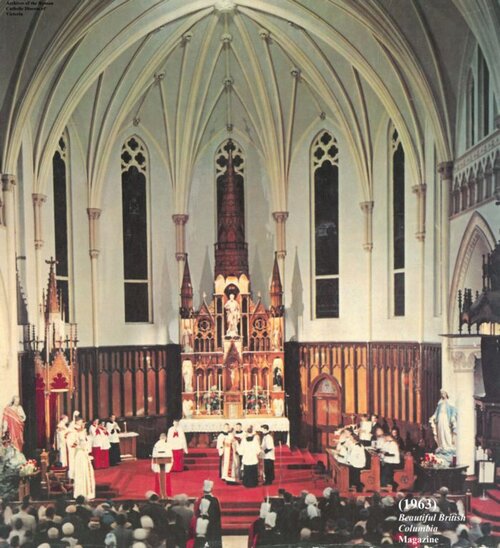
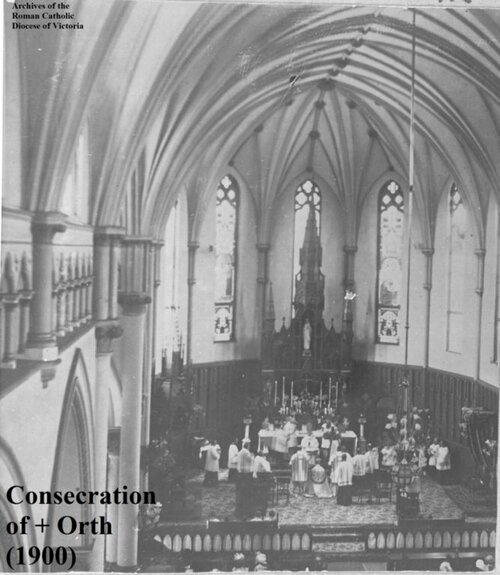
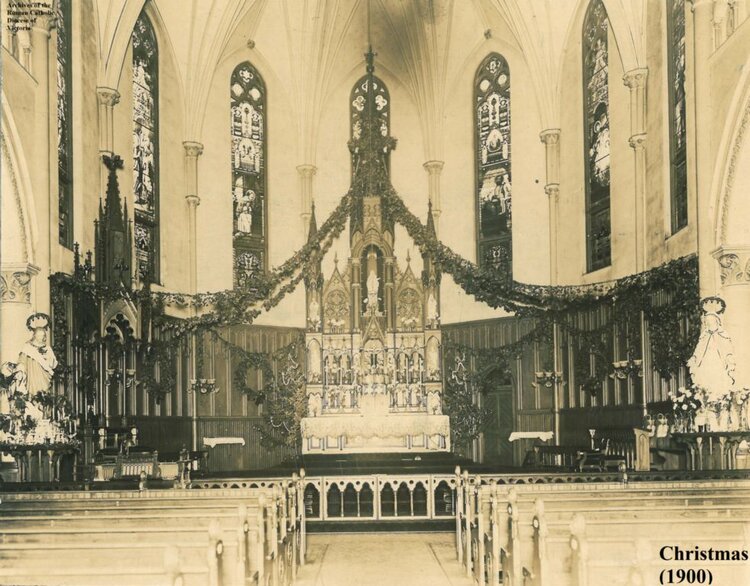
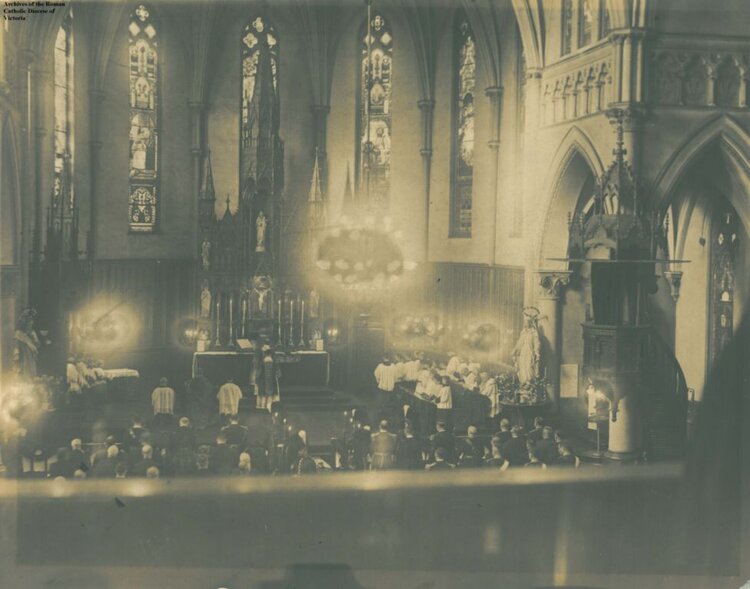
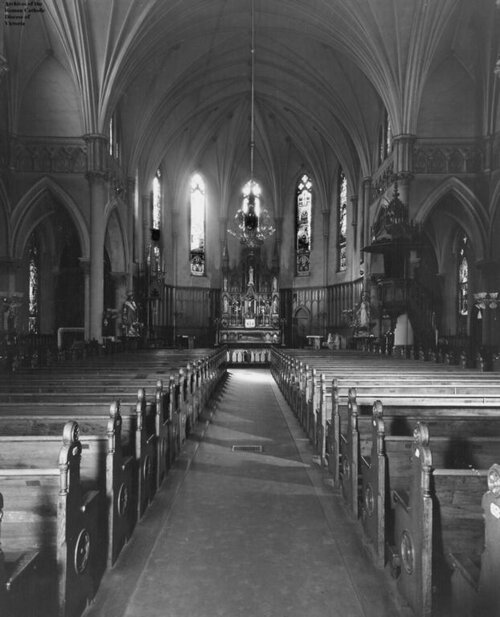
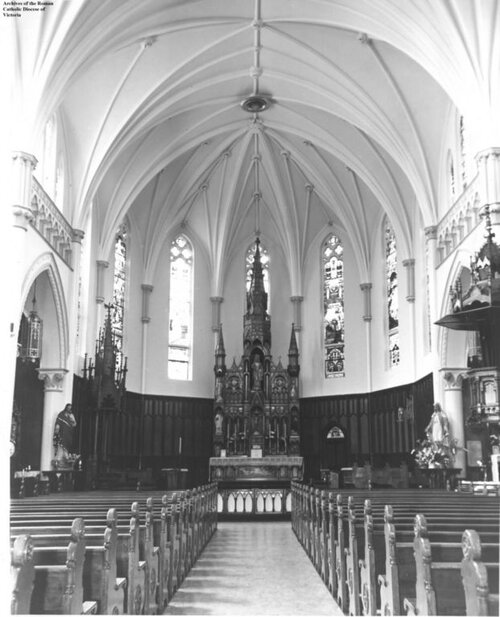
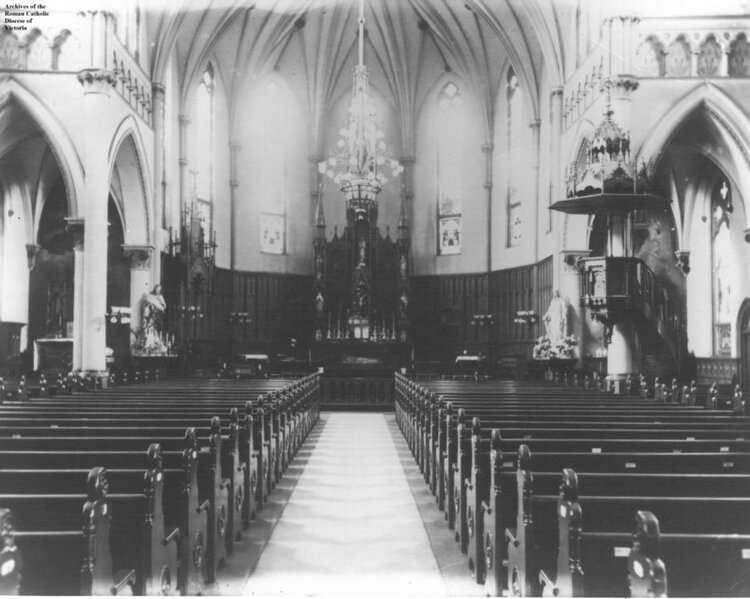
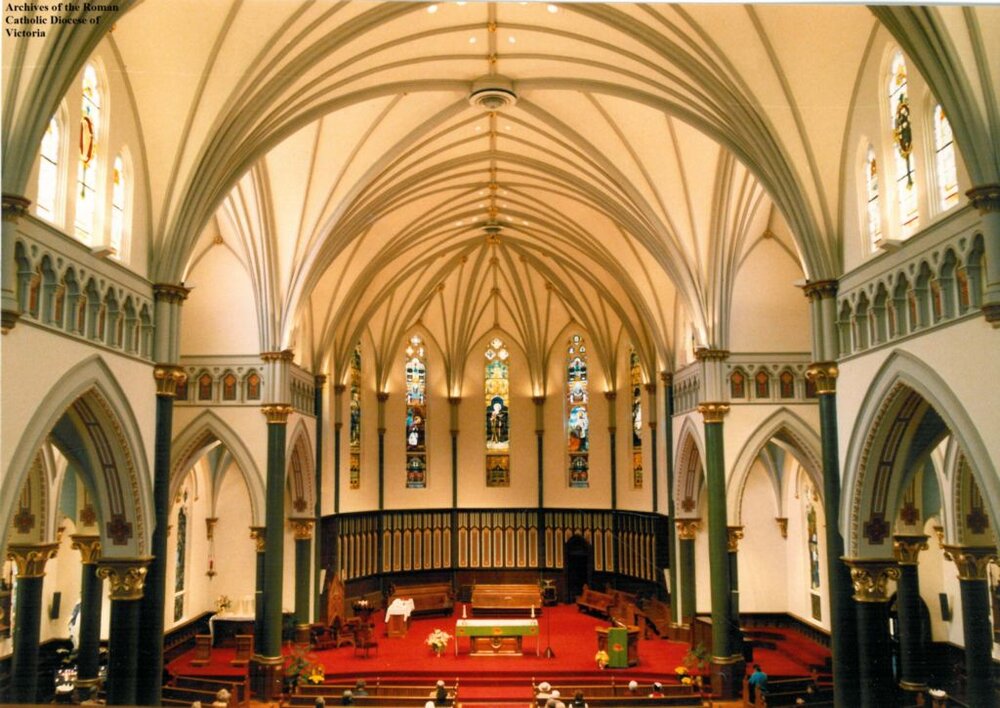
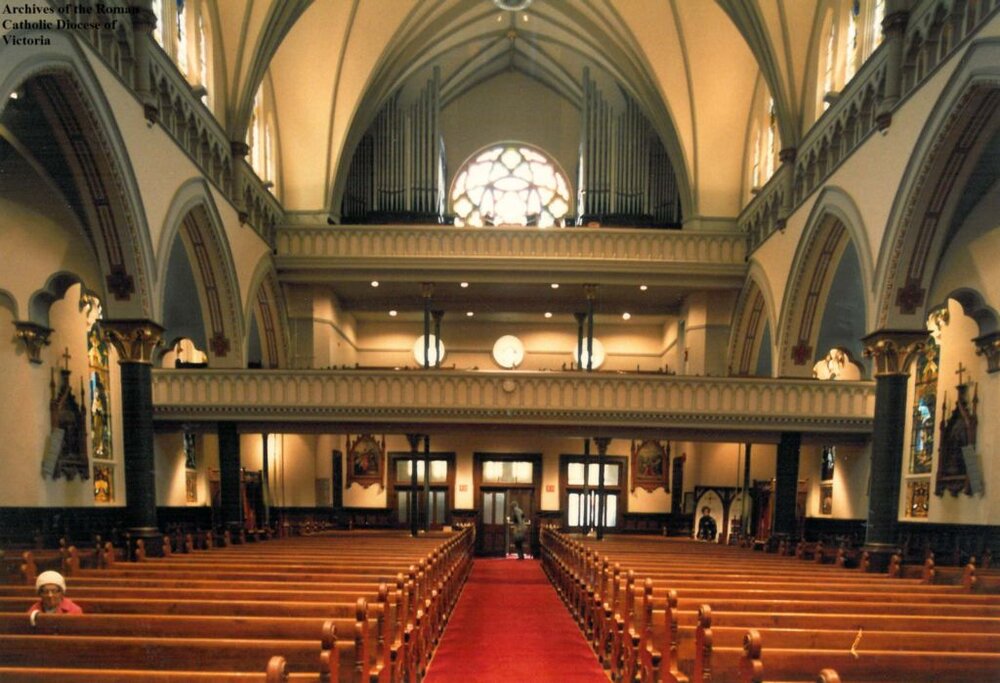
In floor space, St. Andrew's is one of Victoria's largest
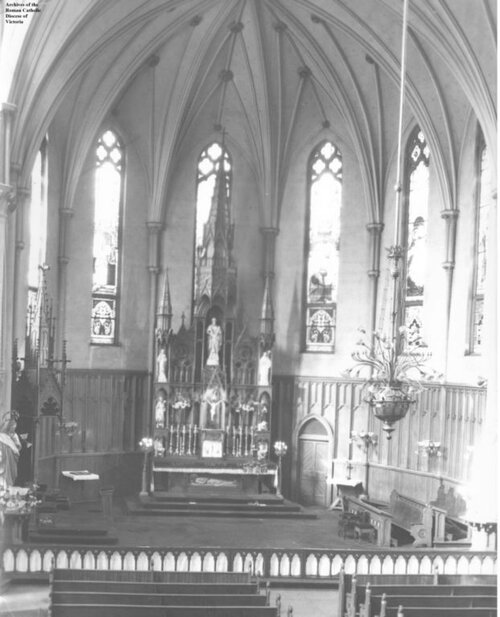
churches. The nave, crossed by a transept and terminating at the
west end in a narrow sanctuary, was designed so that an
uninterrupted view of the altar could be had from any part of
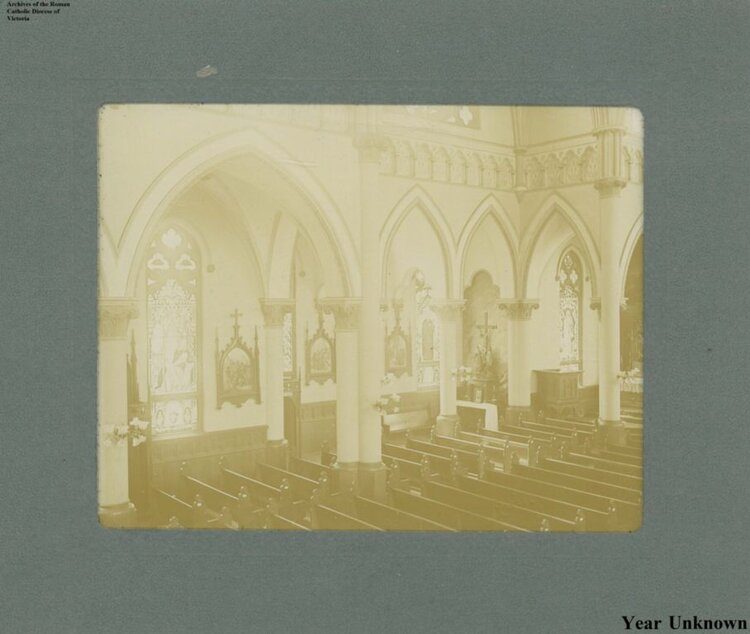
the church. Over the entrance, or narthex, two galleries are
located: the lower originally for the Sisters and school
children: the upper one for the choir. Large rose windows and
bold detailing emphasize the central crossing. Twenty one
feature stained glass windows, commemorating the lives of
Christ, the Virgin and the Saints, flood the church with light
through the side aisles and the chancel. Above them the three
rose windows remain unfinished, although the clerestory windows
are decorated with traditional Christian iconography of the mass
and private devotions.
Below floor level at the northwest corner of the church is a
chapel crypt, assessed via a spiral staircase from the sacristy.
It contains the remains of Archbishop Seghers, Bishop Demers and
Rev John Jonckau. A monument on the View Street side of the
Cathedral further commemorates these three pioneer missionaries
and was erected in 1986 on the centenary of Segher's tragic
death in Alaska.
Immediately west of the Cathedral, and adjoining on View Street
is the "Bishop's Palace." The present classical revival style
building was constructed in 1907 from plans supplied by local
architects Thomas Hooper and C. Elwood Watkins. It was to serve
not only as the residence of the bishop (then actually
Archbishop Bertrand Orth) but would also house several priests,
the chancery, and the "Veritas" library and diocesan archives.
The architects produced a simple but handsome building,
symmetrical in plan and elevation. Brick corner pilasters with
Ionic capitals frame the facades. The central bay with columned
portico is capped by the cornice and gable pediment which
shelters a three-part "Venetian" window. The interior featured
an open three-storey central stairwell lit by a roof-top
skylight. The original finish, oak wainscotting, built-in
cabinetry and art-glass doors, has been much altered. The
Cathedral and Bishop's Palace [no longer called that; it is now
known as the Parish Centre] are designated historic buildings by
the City of Victoria.
The Cathedral is also home to a crypt, where 3 of Victoria's
Bishops lay to rest in peace. For more information on these
Bishops, please click on their names.
- Bishop Modeste Demers:
The First Bishop of Victoria - Archbishop Charles J. Seghers:
Murdered in Alaska, he the Second and Fourth Bishop of Victoria. - Rt. Rev. John J. Johneckau:
A former Vicar General of the Diocese of Victoria, he was named as Bishop but died before he could be consecrated bishop.
The Altar
The new altar was used for the first time
on the twenty-fifth anniversary of Bishop Remi J. De Roo's
Episcopal ordination. It was carved by Mr. Charles Elliott, a
distinguished artist and the first Native Indian to graduate
from St. Louis College.
The use of Christian biblical and liturgical
themes expressed through Native symbol and design brings to
visibility the process of inculturation which has been going
on since the first missionaries came to Vancouver Island. We do
well to recall here the words of His Holiness, Pope John Paul
II, who said, "Thus not only is Christianity relevant to the
Indian peoples, but Christ, in the members of His body is
himself Indian." (Address at Shrine Field, Huronia, Ontario,
September 15, 1984)
The base of the altar consists of two bentwood-like boxes.
These were the traditional means used for carrying and storing
food and belongings as well as the burial boxes of the dead.
Each of these boxes is designed to rotate so that four
different designs may be employed for liturgical seasons and
feasts. The top of the altar or mensa is of yellow cedar and
weighs approximately four hundred pounds. Abalone shells and
Indian designs adorn the frontispiece of the altar.